What Is Damascus Steel? Pattern-Welded Blades Explained
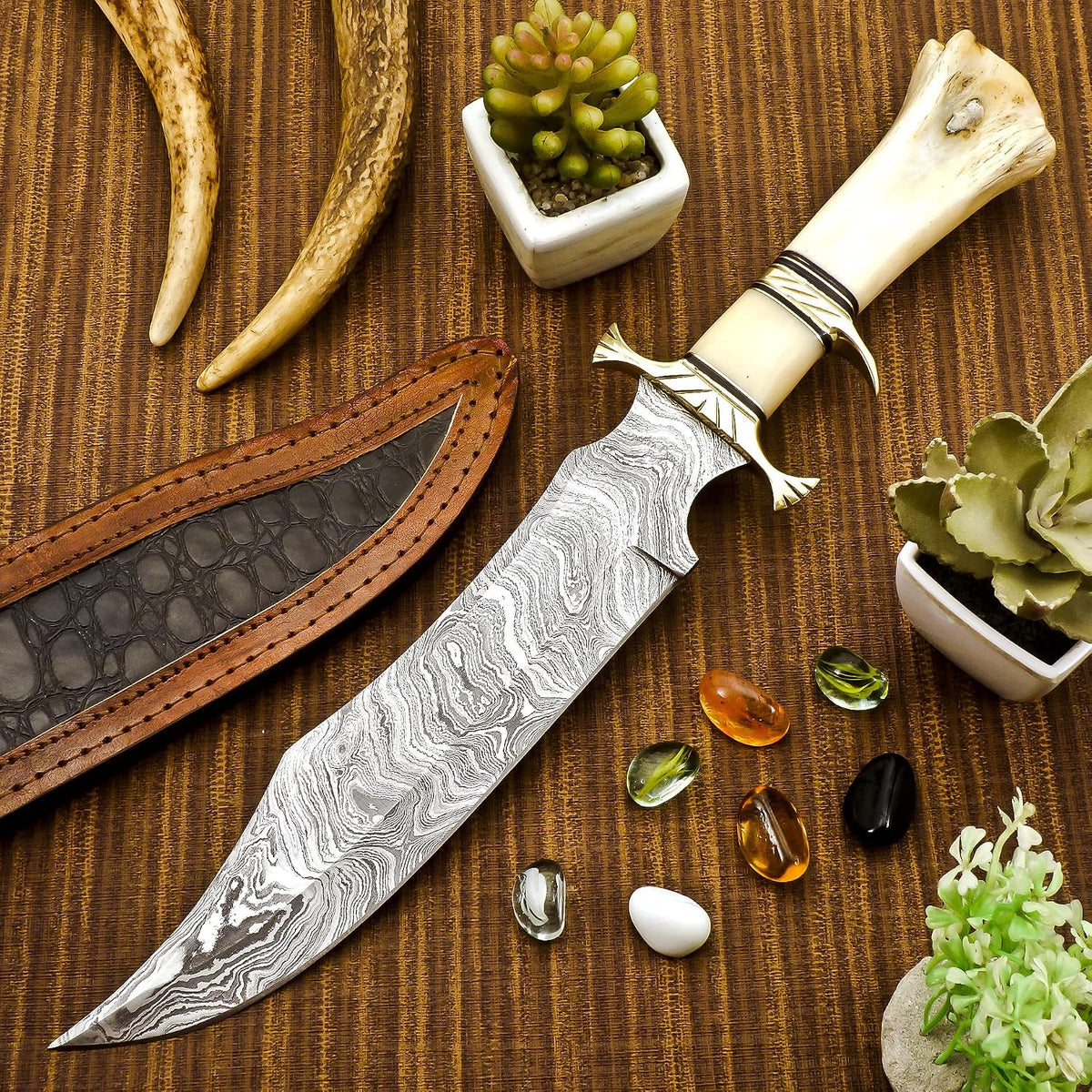
The flowing pattern on a Damascus blade is not paint, engraving or a coating. It is the steel itself: layers of different metals forged together, then etched so the layers show. Here is what the name means today, how a blade is made, and what the numbers on a listing tell you.
Two different things called Damascus
Historic Damascus blades were forged in the Middle East from wootz, a crucible steel made in ingots in southern India and Sri Lanka. Their watery pattern came from bands of hard carbides that formed inside that single steel as it was slowly forged. The craft faded out in the 18th and 19th centuries, and how the smiths controlled it is still studied by metallurgists today.
Modern Damascus, the kind sold almost everywhere now, is pattern-welded steel. Instead of one special steel, the smith forge-welds layers of two different steels into a single bar. Pattern welding is old too: smiths in Europe used it for sword blades through the Migration period and the Viking Age. When a knife listing says Damascus today, it means pattern-welded steel.
How a pattern-welded blade is made
- Stack. Thin plates of two steels are stacked alternately. A common pair is a high-carbon steel such as 1095 (about 0.95% carbon) and 15N20, a steel with about 2% nickel.
- Forge-weld. The stack is heated to welding temperature and hammered or pressed until the layers fuse into one solid billet.
- Draw out, cut and restack. The billet is stretched, cut into pieces and stacked again. Each restack multiplies the layers: four pieces of a 15-layer billet make 60 layers, and doing it again makes 240.
- Pattern. The smith can twist the hot billet, or grind or press grooves and dimples into it before flattening, to create twist, ladder or raindrop patterns. Left alone, the layers give a random, wood-grain look.
- Grind and harden. The blade is shaped, then heat-treated to the target hardness.
- Etch. The finished blade is dipped in a mild acid, commonly ferric chloride. The plain carbon steel darkens, while the nickel-rich layers stay bright. That contrast is the pattern you see.
What the numbers on a listing mean
Layer count describes the pattern, not the strength. More layers give a finer, busier pattern; fewer give bold, wide bands. Past a few hundred layers, individual layers become very thin and the pattern starts to blur.
HRC is hardness on the Rockwell C scale. Most outdoor knives fall between 56 and 60. A harder blade holds its edge longer but is more likely to chip; a softer one is tougher and easier to sharpen.
For example, from the specs on our listings:
- NoonKnives Damascus knife: 10-inch blade, 216 layers of high-carbon Damascus, 56–57 HRC.
- Handmade Damascus Steel Hunting Knife: 9-inch blade, 1095 and 15N20, 288 to 350 layers, 56–57 HRC.
- BK-40 Damascus knife: 10-inch blade, 167 layers, 58–60 HRC.
- Delta Damascus Bowie: 176 or more layers.
Is Damascus stronger than ordinary steel?
Not automatically. How a blade performs depends on the steels chosen and, above all, on the heat treatment. A well-treated single steel can match or beat a Damascus blade on edge retention. People choose Damascus for the pattern, the handwork that goes into it, and because a good Damascus blade still cuts very well.
Real pattern or printed?
Some cheap knives have a pattern laser-etched or printed onto plain steel. To tell the difference:
- Look at the spine. On real Damascus the layers show along the top edge of the blade, not just on the flat sides.
- Look at the edge bevel. The pattern changes where the bevel is ground, because the grind cuts through the layers at an angle.
- Look for repetition. A printed pattern often repeats exactly or looks too uniform.
- Ask about the steels. A maker of real pattern-welded steel can tell you which two steels were used.
Living with Damascus
Because most Damascus is made from carbon steels, it can rust. Keep it dry, oiled and out of the leather sheath between uses. Our Damascus care guide walks through it, and the sharpening guide covers keeping the edge.
See the patterns up close in our Damascus collection.