How to Sharpen a Knife on a Whetstone
A sharp knife is a safer knife: it cuts where you aim it and needs less force. A whetstone takes a little practice, but it gives you more control than a pull-through sharpener and removes less steel. This guide works for fixed-blade hunting knives, Bowies and Damascus blades.
What you need
- A whetstone. A combination stone with a medium side (around 1000 grit) and a fine side (3000 to 6000 grit) covers most sharpening. Add a coarse stone (200 to 600 grit) only if you need to repair chips or a very dull edge.
- Water or honing oil, whichever your stone is made for. Never switch a stone between the two.
- A damp towel to stop the stone sliding.
- A permanent marker to check your angle.
- A leather strop (optional) for the final polish.
Grits at a glance
- 200–600: reshaping, chips, a badly rolled edge. Fast and aggressive.
- 800–2000: routine sharpening. Most edges start here.
- 3000–8000: refining and polishing. A smoother, keener edge.
Choose your angle
Most hunting and outdoor knives are sharpened at about 20 degrees per side. That edge is durable enough for skinning, carving and camp work. A finer 15 to 17 degrees slices more easily but dulls and chips sooner. The simplest rule is to keep the angle the knife came with.
To find it, color the edge bevel with a marker, take two light strokes on the stone, and look. If the ink is gone only at the shoulder of the bevel, lower the spine. If it is gone only at the very edge, raise it. When the ink comes off evenly, you have the angle.
Step by step
- Prepare the stone. Soak a water stone for 10 to 15 minutes if its maker says so, or just wet the surface of a splash-and-go stone. Oil stones get a thin film of honing oil. Set the stone on the damp towel, medium side up.
- Set the angle. Lay the blade on the stone, edge facing away from you, and lift the spine to your angle. A clip-on angle guide helps while you learn.
- Sweep the full edge. Push the blade across the stone from heel to tip in one smooth stroke, with light, even pressure. On the curved belly near the tip, lift the handle slightly so that part of the edge stays in contact.
- Raise a burr. Keep working the first side until you can feel a small rough lip along the whole length of the opposite side. Feel for it by drawing your thumb across the edge from the spine outward, never along it. The burr tells you that side has been sharpened all the way to the apex.
- Switch sides. Sharpen the second side the same way until the burr flips back to the first side.
- Refine. Move to the fine side of the stone. Use lighter pressure and alternate single strokes on each side to shrink the burr.
- Strop. Draw the blade across a leather strop spine-first, so the edge trails, a few times per side. This removes the last of the burr.
- Test. A sharp edge slices cleanly through printer paper held in the air without tearing it.
Gut hooks and recurves
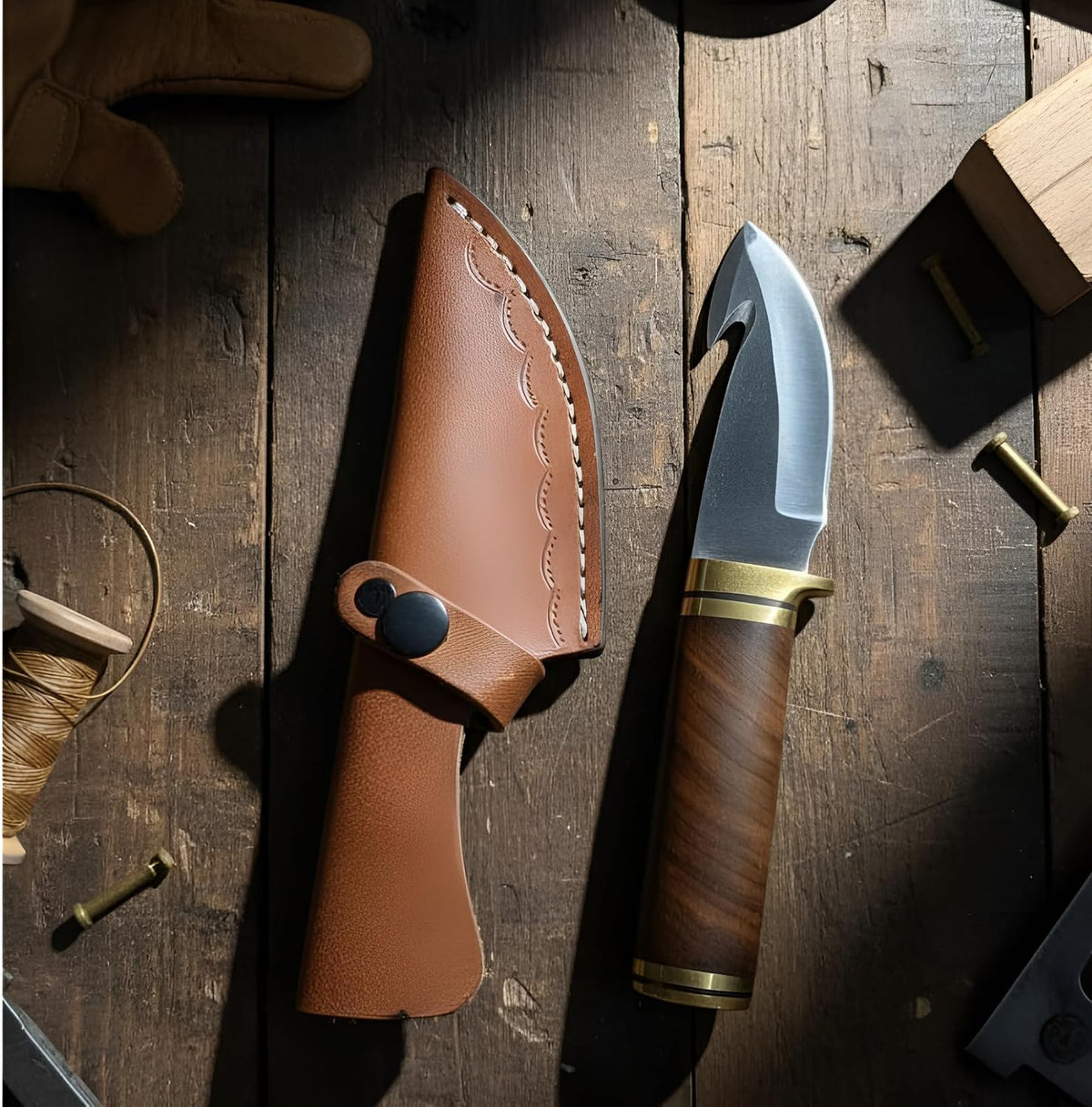
A flat stone cannot reach the inside of a gut hook. Use a tapered ceramic or diamond rod sized to the hook, and stroke along its existing bevel. The same applies to any tight inward curve.
Sharpening a Damascus blade
The technique is exactly the same. Two things to expect:
- The bevel turns bright. Sharpening removes the etched surface at the edge, so the layered pattern fades along the bevel. That is normal. The pattern on the flats is unaffected.
- The steel is high-carbon. A wet stone leaves water on the blade. Rinse, dry the knife completely and wipe on a thin coat of oil as soon as you finish. Our Damascus care guide covers this in detail.
Keep the flats of the blade off the stone. Scratches there show up clearly on an etched pattern.
Honing between sharpenings
An edge that feels dull is often just rolled, not worn away. A few passes on a leather strop or a fine ceramic rod straighten it again. Go back to the stone when stropping no longer brings the bite back.
How often?
Sharpen when the knife stops slicing paper cleanly or starts slipping on a tomato skin or a piece of rope. For a knife used for a few field-dressing jobs a season, that may be once or twice a year. Regular stropping stretches the time between sessions.
Stay safe
- Work slowly on a stable surface, with the stone on a towel.
- Keep the fingers of your guiding hand on the flat of the blade, behind the edge.
- Wear a cut-resistant glove on the guiding hand while you learn.
- Never test sharpness by running a finger along the edge.
Looking for a blade to practice on? Browse our fixed-blade knives or the Damascus collection. New to Damascus? Start with what Damascus steel is and how it is made.


